French Poetic Realism: Essential Films
Fog, fatalism and doomed men on wet streets, 1934–1946: the essential Poetic Realist films, ranked by our composite score across the world's canons.
Poetic Realism was the dominant style of French cinema in the 1930s: studio-built working-class streets, shot in fog and rain, where a doomed hero — usually Jean Gabin — meets a woman, glimpses escape and is destroyed anyway. Marcel Carné and screenwriter Jacques Prévert perfected the fatalism in Port of Shadows and Le Jour se lève, while Jean Renoir bent the style toward something warmer and more political in La Grande Illusion and The Rules of the Game, routinely named among the greatest films ever made. Its designed lighting and moral pessimism fed directly into American film noir, and Carné's Children of Paradise (1945), shot under German occupation, stands as the movement's summation.
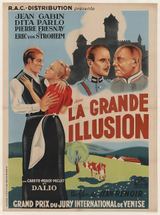
La Grande Illusion (1937) leads with a composite score of 2.53.
- 1La Grande Illusion1937 · Jean Renoir · France · drama2.53
Kinema Junpo Best Ten (International) 1949 #2 · Oscar Best Picture nominee 1938 · Sight & Sound 2022 critics' poll #146
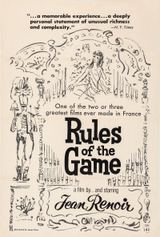
- 2The Rules of the Game1939 · Jean Renoir · France · drama, romance2.38
Sight & Sound 2022 critics' poll #13 · Sight & Sound 2022 directors' poll #38 · Scorsese's 39 essential foreign films
- 3Children of Paradise1945 · Marcel Carné · France · romance, drama2.19
Kinema Junpo Best Ten (International) 1952 #3 · Sight & Sound 2022 critics' poll #136 · TIME All-TIME 100
- 4L'Atalante1934 · Jean Vigo · France · drama, romance1.54
Sight & Sound 2022 critics' poll #34 · Sight & Sound 2022 directors' poll #46 · NYT Best 1,000 Movies
- 5Pépé le Moko1937 · Julien Duvivier · France · crime, drama, romance1.16
Kinema Junpo Best Ten (International) 1939 #1 · Criterion Collection spine #172
- 6Le Paquebot Tenacity1934 · Julien Duvivier · France · comedy1.00
Kinema Junpo Best Ten (International) 1934 #1
- 7Carnival in Flanders1935 · Jacques Feyder · France / Germany · comedy, romance1.00
Kinema Junpo Best Ten (International) 1937 #1
- 8Pension Mimosas1935 · Jacques Feyder · France · drama1.00
Kinema Junpo Best Ten (International) 1936 #1
- 9Un carnet de bal1937 · Julien Duvivier · France · drama1.00
Kinema Junpo Best Ten (International) 1938 #1
- 10A Day in the Country1946 · Jean Renoir · France · drama, romance0.79
Sight & Sound 2022 critics' poll #136 · Empire 500 (2008) #165 · Criterion Collection spine #746
- 11Le Grand Jeu1934 · Jacques Feyder · France · drama, romance0.63
Kinema Junpo Best Ten (International) 1935 #2
- 12La belle équipe1936 · Julien Duvivier · France · drama0.63
Kinema Junpo Best Ten (International) 1937 #2
- 13The Crime of Monsieur Lange1935 · Jean Renoir · France · drama, crime0.62
TIME All-TIME 100 · Sarris's annual top 10 1964 #3 · Rosenbaum's Essential Cinema
- 14Les Visiteurs du Soir1942 · Marcel Carné · France · fantasy, horror, drama0.61
Kinema Junpo Best Ten (International) 1948 #7 · Criterion Collection spine #626 · Rosenbaum's Essential Cinema
- 15
- 16The Lower Depths1936 · Jean Renoir · France · drama, crime0.50
Kinema Junpo Best Ten (International) 1937 #3
- 17La Bandera1935 · Julien Duvivier · France · drama, film-noir0.39
Kinema Junpo Best Ten (International) 1936 #5
- 18The End of the Day1939 · Julien Duvivier · France · drama0.39
Kinema Junpo Best Ten (International) 1948 #5
- 19Port of Shadows1938 · Marcel Carné · France · drama, crime, romance0.35
Empire 500 (2008) #256 · Criterion Collection spine #245
- 20Le Golem1936 · Julien Duvivier · France / Czechoslovakia · horror, drama, fantasy0.32
Kinema Junpo Best Ten (International) 1937 #8
- 21La Charrette fantôme1939 · Julien Duvivier · France · drama0.29
Kinema Junpo Best Ten (International) 1940 #10
- 22Toni1935 · Jean Renoir · France · drama, crime0.27
Criterion Collection spine #1040 · Rosenbaum's Essential Cinema
- 23La Bête Humaine1938 · Jean Renoir · France · drama, crime0.27
Criterion Collection spine #324 · Rosenbaum's Essential Cinema
- 24
- 25


Why this list runs to 1946
Most accounts file poetic realism as a movement of the 1930s, and Wikipedia's does exactly that. Our window closes in 1946 instead, and the choice is deliberate rather than sloppy. Carné's Children of Paradise (1945) is the film the movement was building toward — the last entry in nearly every filmography of the style, and unarguably its culmination. Renoir's A Day in the Country (1946) was shot a decade earlier, in 1936, and only reached screens after the war; dating it by release drops it, dating it by production distorts the ranking. And Duvivier's Panique (1946) is late poetic realism in every particular, made by one of the men who defined the mode. A window that stops at 1940 amputates the movement at exactly the point where its fatalism had somewhere to go.
The opening year is less contentious. 1934 gives us Vigo's L'Atalante, Feyder's Le Grand Jeu and Duvivier's Le Paquebot Tenacity — the style arriving fully formed rather than easing in.
Five filmographies, zero claims
This page is built entirely from a rule, and that is worth saying out loud. Wikidata's "movement" property contributed nothing here: not one film in our library carries a poetic-realism claim. So all 25 titles below arrive the same way — French productions inside the 1934–1946 window by five directors: Jean Renoir, Marcel Carné, Julien Duvivier, Jacques Feyder and Jean Vigo.
The method is honest but coarse. A director-filmography rule takes a whole working period, not a curated selection, which is why Duvivier's Le Golem (1936) and La Charrette fantôme (1939) sit here alongside Pépé le Moko (1937). Read them as what they are: the surrounding output of the men who made the style, not certified specimens of it. What the rule does get right is the movement's actual shape — poetic realism was a house style shared by a small group of directors, writers (Jacques Prévert, Charles Spaak) and designers, not a manifesto anyone signed.
How the ranking falls
Renoir takes the top two positions — La Grande Illusion (1937) at #234 and The Rules of the Game (1939) at #260 — which tracks Wikipedia's own assessment of him as perhaps the movement's most significant figure. Children of Paradise follows at #311, and Vigo's L'Atalante reaches #569 on the strength of a single feature, the best score-per-film ratio on this page by a wide margin.
Duvivier is the page's volume leader with nine titles, and also its clearest reputation gap: Pépé le Moko is his highest entry at #917, far below the Renoir pair. To my eye the composite is underweighting Carné more seriously still — Port of Shadows (1938) lands at #3376, which reads as a canon-formation artifact rather than a verdict on the film. The list ranks by measured canonical weight across the world's polls, not by how tidy the movement's story would be if it agreed.