German Expressionism: Essential Films
Painted shadows, paranoid architecture and the birth of horror, 1919–1933: the essential German Expressionist films, ranked by our composite score.
German Expressionism was the first great art movement of cinema, flourishing in the Weimar Republic from The Cabinet of Dr. Caligari (1920) to the coming of sound. Working entirely in the studio, directors like Robert Wiene, F. W. Murnau and Fritz Lang built distorted painted sets, carved space with hard shadow and made the frame express a character's inner derangement — inventing the visual language that horror and film noir still speak. When the Nazi era scattered its talent, that language emigrated with them to Hollywood.
Metropolis (1927) leads with a composite score of 2.18.
- 1Metropolis1927 · Fritz Lang · Weimar Republic · silent, drama, sci-fi2.18
Sight & Sound 2022 critics' poll #67 · Kinema Junpo Best Ten (International) 1929 #4 · TIME All-TIME 100
- 2M1931 · Fritz Lang · Germany / Weimar Republic · thriller, film-noir, drama1.66
Sight & Sound 2022 critics' poll #36 · Letterboxd Top 250 #175 · Empire 500 (2008) #212
- 3The Last Laugh1924 · F. W. Murnau · Germany / Weimar Republic · silent, drama1.25
Kinema Junpo Best Ten (International) 1926 #2 · Sight & Sound 2022 critics' poll #243 · Roger Ebert's Great Movies
- 4Nosferatu1922 · F. W. Murnau · Germany · silent, horror, drama1.20
Sight & Sound 2022 critics' poll #196 · Scorsese's 39 essential foreign films · Vatican film list
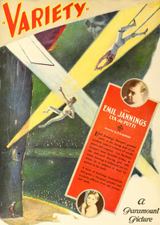
- 5Variety1925 · Ewald André Dupont, Nicolas Farkas · Germany · drama, silent0.63
Kinema Junpo Best Ten (International) 1927 #2
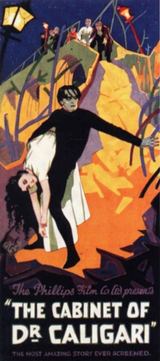
- 6The Cabinet of Dr. Caligari1920 · Robert Wiene · Germany · silent, horror, crime0.53
Kurosawa's 100 favorite films · Roger Ebert's Great Movies · Edgar Wright's 1,000 favorite movies
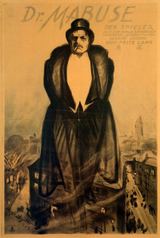
- 7Dr. Mabuse the Gambler1922 · Fritz Lang · Germany · silent, thriller, crime0.52
Scorsese's 39 essential foreign films · Kurosawa's 100 favorite films · Rosenbaum's Essential Cinema
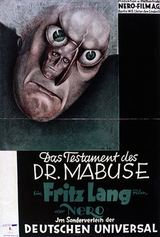
- 8The Testament of Dr. Mabuse1933 · Fritz Lang · Germany / Weimar Republic / France · crime, horror, drama0.38
Criterion Collection spine #231 · Edgar Wright's 1,000 favorite movies · Rosenbaum's Essential Cinema
- 9Faust1926 · F. W. Murnau · Germany / Weimar Republic · silent, drama, fantasy0.36
Roger Ebert's Great Movies · Edgar Wright's 1,000 favorite movies · Rosenbaum's Essential Cinema
- 10Destiny1921 · Fritz Lang · German Reich / Germany · silent, drama, fantasy0.11
Rosenbaum's Essential Cinema
- 11Crime and Punishment1923 · Robert Wiene · Weimar Republic / Germany · silent, drama0.11
Rosenbaum's Essential Cinema
- 12
- 13Spies1928 · Fritz Lang · Germany / Weimar Republic · silent, drama, thriller0.11
Rosenbaum's Essential Cinema
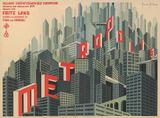
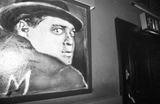
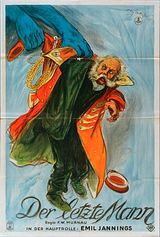
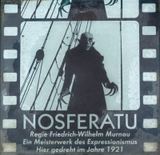
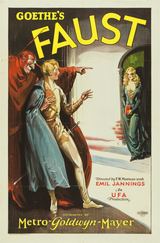
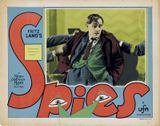
German Expressionism is the movement that taught cinema light could lie. Where the American studios were building an invisible style meant to pass for reality, the directors of the Weimar Republic did the opposite — they painted shadow directly onto the set, tilted the architecture until it leaned like a bad dream, and made the frame report a character's derangement rather than the room he stood in. Arguably cinema's first fully self-conscious art movement, it lasted barely fifteen years and changed the way every horror film and every film noir is lit to this day.
The Weimar window
The page runs 1919 to 1933, the near-exact span of the Republic that produced it. The Cabinet of Dr. Caligari (1920), with its literally painted sets and impossible angles, is the usual starting gun; the movement's late edge carries Fritz Lang's M (1931) and The Testament of Dr. Mabuse (1933), which most historians still file as late Expressionism even as sound arrives and the style curdles into something harder. Its defining grammar — distorted set design, chiaroscuro lighting, stylised acting and warped camera angles — is largely the work of five directors: Robert Wiene, F. W. Murnau, Fritz Lang, Paul Leni and Ewald André Dupont, most of them orbiting the UFA studio.
What it changed and how it ended
The movement built the haunted house that horror has lived in ever since: Murnau's Nosferatu (1922) and Wiene's Caligari invented the vocabulary of dread — the looming shadow, the diseased town, the monster who is also a metaphor — while the same chiaroscuro would later become the standard cinematography of American film noir. That transmission was not gradual but violent. M was Lang's first sound film; his Testament of Dr. Mabuse was banned by the new Nazi regime on 30 March 1933, and Lang left Berlin permanently that July, moving through Paris to Hollywood, where he was naturalised in 1939. The style emigrated with its makers, which is why the light of Weimar Berlin ended up falling across the faces of doomed men in 1940s Los Angeles.
How to read our list
The ranking is by composite score, not chronology or reputation, and the gap between the two is the interesting part here. Metropolis (1927), Lang's dystopian monument, is the movement's highest entry on our list; M follows as the second. The Cabinet of Dr. Caligari — the film that arguably started everything — sits only sixth by score, a clean illustration of the difference between historical primacy and accumulated canonical weight. Membership is carried by rule rather than by database tag: because Wikidata's movement field is nearly empty here, the page is assembled from the canonical Expressionist directors working in Germany inside the Weimar window, which is why Lang's crime serials (Dr. Mabuse the Gambler, 1922; Spies, 1928) appear alongside the acknowledged classics — and why G. W. Pabst, whose New Objectivity belongs to a colder, later Weimar, does not.