Quentin Tarantino
American filmmaker and actor (born 1963)
A director's score is the sum of their films' composite canon scores — methodology.
- Born
- March 27, 1963 · Knoxville
- Nationality
- United States
- Directing career
- 15 directorial credits, 1987–2019 · first: My Best Friend's Birthday (1987) · latest: Once Upon a Time in Hollywood (2019)
- Work
- actor, screenwriter, film director, film producer
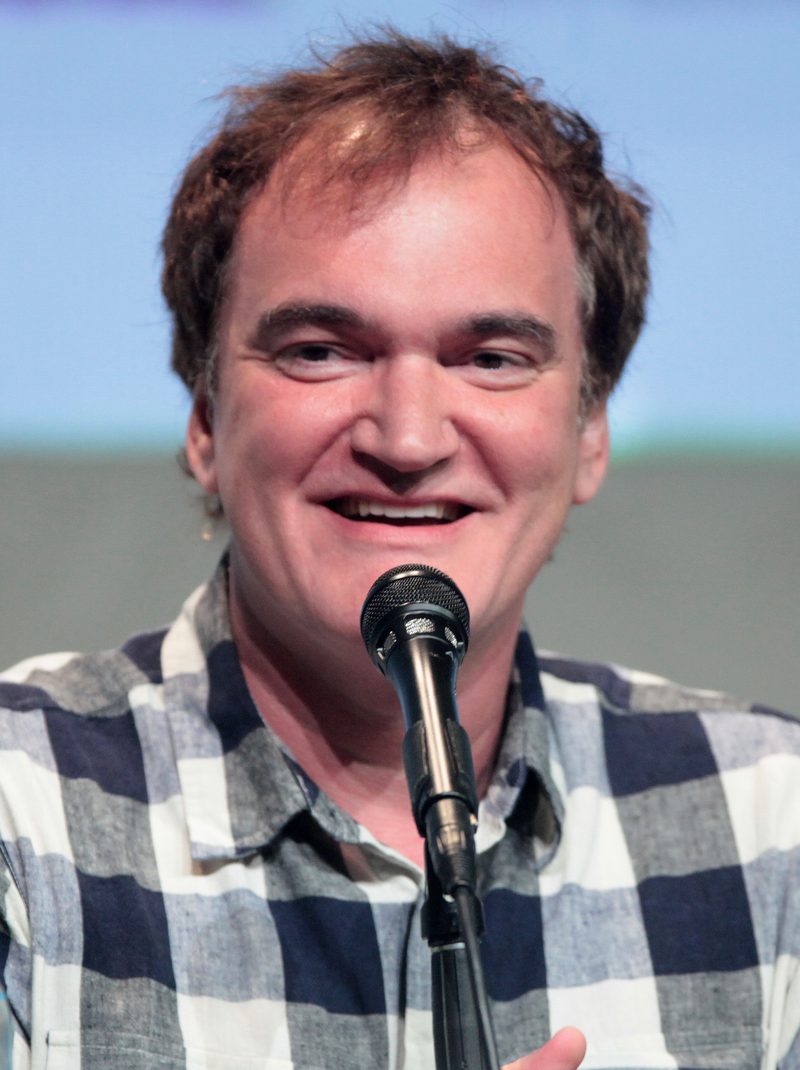
The video clerk who rewired the decade
Tarantino is the rare director whose influence you can hear before you can see it — a generation of screenwriters learned their cadence from him, the digressive, profane, pop-saturated talk that turns a diner booth or a car ride into a set piece. He has been called the most influential director of his generation, and the claim is defensible on dialogue alone. What makes him matter, to my eye, is that he proved a total autodidact working entirely inside genre — heist, revenge, war, Western — could produce something the culture treated as high art. He never went to film school; he went to films. The line is a joke, but it is also the whole method.
Knoxville to Cannes
Born in Knoxville, Tennessee on March 27, 1963, he spent five years behind the counter of a California video store, Video Archives, absorbing the exploitation and martial-arts back catalogue that would become his raw material. Reservoir Dogs (1992) premiered at Sundance and made him instantly notorious; two years later Pulp Fiction (1994) took the Palme d'Or at Cannes and won him the Academy Award for Best Original Screenplay, shared with Roger Avary. A second screenwriting Oscar followed for Django Unchained (2012). Across the run — Jackie Brown (1997), the two Kill Bill volumes (2003 and 2004), Death Proof (2007), Inglourious Basterds (2009), Once Upon a Time in Hollywood (2019) — his films have grossed more than $1.9 billion worldwide, an unusual figure for work this idiosyncratic. He has long floated a plan to stop at ten features, and the discipline of that self-imposed ceiling is itself part of the persona.
Structure as attitude
The signatures are famous: the shuffled chronology, the chapter cards, the sudden eruptions of violence bracketed by long stretches of talk that circle everything except the plot. But the deeper move is curatorial. Tarantino treats film history as an open library to be recombined, and his editor Sally Menke — his self-described number-one collaborator until her death in 2010 — was the one who kept the recombinations legible. His films are arguments about other films, which is why they reward the second viewing more than the first.
What the numbers say
Here the reputation and the aggregate part company hard. Our library ranks Tarantino #28 among all directors at a composite 17.45 — respectable, but nowhere near the "most influential of his generation" framing. The reason is concentration: almost the entire score rides on one film. Pulp Fiction sits at #11 overall (5.76), cited by 18 of our sources — a genuine canonical peak. After that the curve falls off a cliff. Inglourious Basterds lands at #267 (2.36), Once Upon a Time in Hollywood at #365, both Kill Bill volumes near #789–798, Reservoir Dogs down at #976, Django Unchained at #1091, Jackie Brown at #1302. This is what a genre auteur looks like in a critics'-poll aggregate: beloved, endlessly watched, and — apart from the one masterpiece the canon has fully absorbed — under-cited by the "greatest films" lists our score is built from. The influence is real; the accumulation is thin.
Where to start
Pulp Fiction, without argument — it is both his best film and, by our numbers, the only one the canon has unreservedly embraced. Then Jackie Brown for the patience underneath the flash, and Inglourious Basterds for the war-movie revisionism at full, gleeful throttle.
Films in our library, ranked
Ranked by composite canon score across 20+ authoritative lists, awards and polls — our ordering, with every placement citing its evidence on the film's page.
- 1
1994 · United States · crime, drama, thriller
Palme d'Or winner 1994 · Empire 500 (2008) #9 · Oscar Best Picture nominee 1994
5.7618 citations - 2
2009 · Germany / United States · war, drama, adventure
Cahiers du Cinéma annual top 10 2009 #3 · Oscar Best Picture nominee 2009 · Film Comment year-end poll 2009 #7
2.368 citations - 3
2019 · United States / United Kingdom · comedy, drama, crime
Kinema Junpo Best Ten (International) 2019 #2 · Film Comment year-end poll 2019 #3 · Oscar Best Picture nominee 2019
2.065 citations - 4
2004 · United States · action, thriller, drama
Ebert's annual top 10 2004 #2 · Film Comment year-end poll 2004 #8 · Cahiers du Cinéma annual top 10 2004 #9
1.305 citations - 5
2003 · United States · action, thriller, crime
Film Comment year-end poll 2003 #4 · Kinema Junpo Best Ten (International) 2003 #10 · Kehr's annual top 10 2003 #4
1.295 citations - 6
1992 · United States · crime, thriller, drama
Kinema Junpo Best Ten (International) 1993 #6 · Kehr's annual top 10 1992 #3 · Empire 500 (2008) #97
1.115 citations - 7
2012 · United States · western, action, drama
Oscar Best Picture nominee 2012 · Film Comment year-end poll 2012 #21 · Letterboxd Top 250 #125
1.004 citations - 8
1997 · United States · crime, drama, thriller
Cahiers du Cinéma annual top 10 1998 #10 · Ebert's annual top 10 1997 #5 · Empire 500 (2008) #215
0.935 citations - 9
2005 · United States · crime, film-noir, drama
Cahiers du Cinéma annual top 10 2005 #8 · Sarris's annual top 10 2005 #4 · Film Comment year-end poll 2005 #41
0.904 citations - 100.631 citation
- 11
2004 · United States · action, thriller
Edgar Wright's 1,000 favorite movies
0.111 citation

Complete filmography
All 15 directorial credits recorded on Wikidata, in chronological order; films in our library link to their canon-score page.
- 1987My Best Friend's Birthday
- 1992Reservoir Dogs
- 1994Pulp Fiction
- 1995Four Rooms
- 1997Jackie Brown
- 2003Kill Bill: Volume 1
- 2004Kill Bill: The Whole Bloody Affair
- 2004Kill Bill: Volume 2
- 2005Sin City
- 2007Death Proof
- 2009Inglourious Basterds
- 2012Django Unchained
- 2015The Hateful Eight
- 2019Once Upon a Time in Hollywood
- —Reservoir Dogs: Sundance Institute 1991 June Film Lab